
EXECUTIVE SUMMARY
Documentation is not the problem. Distribution, versioning and proof are.
Regulation (EU) 2023/1230 replaces the Machinery Directive and applies from 20 January 2027. Most of what it demands of technical documentation is familiar. What is new sits in Article 10(7), which permits instructions in digital form and then defines what digital provision means.
Five requirements are binding, and each one is an infrastructure requirement rather than a documentation one:
- Ten-year availability. The manufacturer must keep documents online for the expected lifetime of the machine and for no less than ten years.
- Unique identification. A durable access reference on the machine, linking to that machine's documentation.
- Format. Downloadable, storable locally, printable.
- Paper fallback. Free of charge, supplied within one month of a request.
- Tamper-proof archiving. Released versions cannot be altered or overwritten without a record.
Meeting them is an execution problem. For a manufacturer with an active dealer or distributor network, the question is not what to document, but how to get the right version of that documentation to the right dealer, and prove it afterwards. The usual plan is email and PDFs. It does not scale: every specification change triggers a new send round, dealers end up on outdated versions, and no audit trail shows who held what, and when.
The alternative is one source of truth the manufacturer maintains and dealers query themselves — machine by machine, in their language, always current. A public level meets the regulation. A registered level turns every login into an identified operator with a known machine park, serial number, and purchase date.
This paper sets out what each requirement demands technically, why the three most common approaches fail against them, and what the return is on infrastructure built to satisfy a legal obligation.
Why the usual approaches fall short
Machine manufacturers across the DACH region know the regulation is coming. The issue is not a lack of awareness. The execution gap is.
What the problem looks like in practice
A manufacturer with 30 dealers across DACH and France faces the same questions every time a specification changes or a compliance statement is updated:
- Who notified which dealer, on which date, with which version?
- Which dealers hold the current version, and which are still working from the old one?
- If a regulator asks for proof of notification, where is the audit trail?
- When the same change affects six machine types, how many separate emails go out?
- When a French dealer needs the document in French, who translates and sends it?
None of this is new. Manufacturers have run it on email and PDFs for years. The regulation does not create the problem; it raises the stakes. After January 2027, "we sent an email" is no longer sufficient evidence. The regulation requires documented access, versioned records, and a ten-year availability obligation.
The email-and-PDF chain has three failure modes that matter legally:
- No version control – you cannot prove which version a dealer held at the time of a claim.
- No audit trail – you cannot prove who received what, and when.
- No continuity – when a specification changes, old emails and PDFs keep circulating.
Three alternatives come up in almost every conversation with machine manufacturers. None of them reliably satisfies the regulation. Here is why, and why each failure matters.
Approach 1: PDFs on the corporate website
Where it breaks
The next website migration kills the QR codes on machines already delivered.
The corporate website follows the marketing lifecycle — redesign every three to four years, new URL structure, new CMS. The QR code printed on the type plate of a machine delivered in the first year of the regulation links to a URL that may not exist three years later.
- No versioning – which version did which dealer see, on which date?
- No audit trail – you cannot prove what was accessible when.
- No tamper-proof archiving – documents can be overwritten without a record.
- No operational plan – who is responsible for availability in year eight?
- No dealer access layer – the website serves the public, not your distribution network.
Approach 2: The ERP portal as the sole solution
Where it breaks
Dealers who are not in your ERP have no access.
The ERP portal works for customers already in the system. But the regulation requires access for every operator of the machine, not only direct ERP contacts. And ERP portals rarely carry a document-level audit trail.
- No open access without an ERP account, which excludes end users and non-ERP dealers
- No record of which version an external party accessed, on which date
- An ERP lifecycle built around business process logic, not ten-year archiving
- Serial-number deeplinks and QR routing that are not standard ERP capabilities
Approach 3: Custom development by the internal IT team
Where it breaks
Authentication, multilingual delivery, and ten-year operations are underestimated at scoping.
Custom builds start as manageable projects and become permanent ones. The requirements accumulate: dynamic URL routing so QR codes survive server migrations, localisation into the delivery country's official language, tamper-proof archiving, audit trail, high availability, double opt-in for the registered layer.
- Scoping errors surface as budget overruns and missed timelines
- Internal IT is rarely sized for ten-year operational responsibility
- Security requirements get retrofitted after the fact
- No SLA, no guaranteed uptime, no continuity commitment
Why this is an execution problem, not a compliance problem
The compliance team signs off the content. Someone else handles the rollout: updating the website, notifying dealers, versioning documents, distributing to 30 or 50 partners in several languages.
In most manufacturing companies that work lands on marketing. No additional headcount, no new budget. This is the gap no compliance consultant addresses, because it is not a compliance problem. It is a communications infrastructure problem.

What the regulation actually requires
Regulation (EU) 2023/1230 replaces Machinery Directive 2006/42/EC and applies from 20 January 2027 to every manufacturer placing machinery on the EU market. No size threshold. As a regulation rather than a directive, it takes effect in every member state without national implementation.
The most common misunderstanding: digital is permitted, not simplified
Article 10(7) permits the manufacturer to provide instructions in digital form rather than on paper. Most manufacturers read that as a simplification. It is not. The same article defines what digital provision means, and the conditions are harder to meet than the paper ones.t
Digital provision means ten years guaranteed.
Not "upload once". Not "put it on the website".
Ten years stable, versioned, provable – with the document that was current at the time of delivery.
The five binding requirements
Ten-year availability
The manufacturer must keep all documents accessible online for the expected lifetime of the machine, and for no less than ten years from the date of placing on the market. This applies to the version current at delivery.
No operational plan for year eight or year ten. "We will deal with it then" is not a plan.
Unique identification / QR code
A direct access reference on the machine, the packaging, or the accompanying document, linking to the machine-specific documentation.
A static QR code pointing straight at a PDF. It breaks at the next website migration.
Format
Documents must be downloadable, storable locally, and printable. PDF is the de facto standard.
An online viewer without a download option does not satisfy Art. 10(7).
Paper fallback
The customer may request a paper version free of charge. The manufacturer must supply it within one month.
No process defined for the one-month deadline. Effort and owner undefined.
Tamper-proof archiving
Released versions must not be altered, overwritten, or deleted without a record. Write once, read many (WORM). The document management system is the central instrument of evidence.
A DMS without WORM capability, or without a complete audit trail.
The liability consequence: a portal outage is a missing instruction manual
A portal outage is legally equivalent to a missing instruction manual — and therefore constitutes a notifiable product defect.
High availability is not a technical preference. It is a legal obligation. An internal web server without an SLA does not meet it. Neither does a folder on the marketing website.
The Machine Documentation Portal: One source of truth
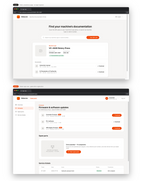
A machine documentation portal replaces the email chain with one structured, self-service access point. It carries its own lifecycle, independent of the marketing website. And it works in two levels: one maps to the regulation, the other to dealer value.
The manufacturer maintains one source of truth.
Dealers query it themselves – machine by machine, in their language, always current.
No email chain. No version drift. Full audit trail.

Level 1 – Legal obligation (public, no login)
Level 1 meets the minimum standard of the regulation. It is public: no registration, no login, no paywall. Any dealer, any end user, any inspector reaches the required documentation without a barrier.
Instruction manuals as PDF
Downloadable, storable locally, printable. Platform-independent.
Art. 10(7)
EU Declaration of Conformity
Versioned, with release date and tamper-proof archiving.
Art. 10(7)
QR routing to the machine page
Dynamic URLs that stay valid after server migrations. Serial number mapped to type-specific documentation.
Art. 10(7)
Serial number search
Direct page access by serial number, rather than a generic search form as the entry point.
Best practice
Plain-text URL fallback
A short, readable web address beside the QR code, for manual entry without a camera.
Best practice
Ten-year tamper-proof archiving
Released versions cannot be overwritten. Timestamped audit trail of creation, release, and access.
Art. 10(7)
Language switching
Localisation by QR parameter or language selection. Output in the official language of the delivery country.
Art. 10(7)
Request a paper copy
CRM or ERP trigger, automated print-on-demand. Deadline: one month from the request.
Art. 10(7)
Two things sit outside the portal and stay with the manufacturer. Metadata discipline is the first: documents cannot live as loose files, and each one has to carry links to part numbers, production years, machine types, and serial numbers. Print quality is the second: production IT applies the QR code to the type plate in weather- and abrasion-resistant industrial quality. No portal compensates for a code that has worn off.
Level 2 – Dealer value (login via double opt-in)
Level 2 is not required by law. It is the return on the compliance investment. Every dealer who registers becomes an identified operator, and an anonymous download becomes a qualified B2B contact.
Firmware and software updates
Email notification when new versions are released.
Dealers stay current without manual distribution
CAD files, STEP files, EPLAN macros
Download for OEM partners and technical integrators.
Reduces inbound support volume
Individual calibration certificates
Serial-number-specific certificates on demand.
Relieves technical customer service
Interactive exploded-view diagrams
Direct jump to the spare parts shop from inside the diagram.
Spare parts upsell from within the documentation
Service ticket and maintenance history
Ticket creation in the portal, history visible to the dealer.
CRM integration, 360-degree customer view
Identified operators
Who operates which machine, under which serial number.
Warm outreach for service contracts, retrofits, recalls
How a document reaches the machine
The end-to-end flow connects the systems without manual steps.

Customer order confirmed, machine X with serial number Y complete
CRM / ERP
Production completion
Matching modular instruction manual assembled
Editorial system
Trigger from CRM
Manual frozen in the tamper-proof archive, dynamic link generated
DMS
Trigger from the editorial system
Link sent to the laser printer, QR code applied to the type plate
Production
Trigger from DMS
PDF published in the portal
Portal
Same trigger as the previous step
On request: PDF printed and dispatched within one month
CRM + print-on-demand
Customer request
The commercial return on a compliance requirement
The regulation forces this channel into existence. A manufacturer with 30 or 50 or 100 downstream partners — dealers, distributors, service agents — has no reliable picture today of who operates which machine, at which site, on which version of the documentation. Level 2 registration turns an anonymous download into a CRM record.
Manufacturers who build it well get more than compliance. They get a direct line to their machine operators, and an argument for contract length that sales does not otherwise have.
What anonymous downloads become
Anonymous download. No name, no company.
Identified operator with full contact details
No record of which machine is operated
Machine park per operator in the CRM
No proof of which version someone held
Audit trail: who accessed which version, when
Service contact after delivery left to chance
Targeted outreach: spare parts, service contracts, retrofit
Recall communication as an unfiltered mass email
Recall to the affected serial number cohort only
What identified operators make possible
- New firmware released – notification to operators of the affected machine types only
- Safety advisory – direct outreach to the affected serial number cohort, not a mass mailing
- Spare parts – contextual upsell from inside the exploded-view diagram
- Service contracts – a renewal trigger per operator at contract expiry
- Retrofit campaigns – outreach to every operator of an older product line, machine park known
The ten-year availability obligation gives sales an argument about contract duration it does not otherwise have. A customer who needs documented availability for a decade negotiates differently about term length and cancellation.

The capabilities behind the portal: what you need, what you already have
The two-level portal is not a single product. It is four capabilities working together, and most manufacturers already run three of them for other purposes. Where those capabilities sit on one platform, no integration work is needed between third-party systems.
Customer and machine data (CRM)
Machine data, serial numbers, customer assignment, operator identification from Level 2 logins, one-month trigger for print-on-demand requests.
Usually already in place
Portal and web platform
Level 1 and Level 2 on one platform, with a lifecycle independent of the marketing website. QR deeplinks, dynamic routing, serial number search, language switching, double opt-in for Level 2.
Usually the only new component
Marketing automation
Notifications for new document versions in Level 2. Firmware update triggers. Recall communication to the affected serial number cohort.
Depends on existing setup
Web analytics
Access proof per serial number and version. Access history for audit preparation. Usage analysis for service optimisation.
Depends on existing setup
The practical consequence:
Manufacturers already running a customer data platform and marketing automation typically need one new component, not a new system landscape. No new IT project, no new infrastructure budget — a new use case on platforms the team already knows.
The build-out path: from compliance to full operator channel
Phase 1: Regulatory compliance. Level 1 live, QR code on the type plate.
Portal platform + machine data
The date the regulation applies
Phase 2: Identify operators. Level 2, double opt-in, machine park in the CRM.
Customer data platform
First portal logins
Phase 3: Update communications. Firmware notifications, recall cohort outreach.
Marketing automation
First recall or update event
Phase 4: Proof and optimisation. Audit preparation, usage analysis.
Web analytics
Audit preparation or compliance review
Phase 5: Full website and product pages.
Portal platform, full build-out
Second expansion phase after Phase 1

Implementation: how long this actually takes
The regulation applies from 20 January 2027. The more useful number is not the date but the lead time in front of it, because that is the part a manufacturer controls.
Counting backwards from the day the portal has to be live, a first phase runs about 24 weeks end to end. The phases are sequential: concept work cannot start until the data mapping is agreed, and testing cannot start until the QR routing exists.
Decision and commissioning
T–24 weeks
Internal: sign-off, vendor selection
Concept and data mapping. Machine types, serial number logic, language versions.
T–20 weeks
3–4 weeks with JustRelate Solutions
Implementation and integration. Portal build, CRM connection, QR routing.
T–16 weeks
4–6 weeks depending on complexity
Testing and acceptance. QR codes tested, audit trail verified, paper fallback tested.
T–8 weeks
2–3 weeks
Go-live and training
T–4 weeks
1 week rollout
(T is the date the portal has to be live — for most manufacturers, the day the first machine ships with a QR code on its type plate.)
The practical consequence:
Manufacturers already running a customer data platform and marketing automation typically need one new component, not a new system landscape. No new IT project, no new infrastructure budget — a new use case on platforms the team already knows.
Pilot approach: running within a few weeks
You do not need to onboard every machine type at once. A pilot with one or two machine types and one dealer group runs within a few weeks, and gives you a working proof of concept to test with real dealers.
- Define 1–2 machine types
- Provide serial number logic and current documentation
- Set up the portal, test QR codes end to end
- Invite a pilot group of dealers, Level 1 and optionally Level 2
- Collect feedback, adjust, roll out to the remaining types
The pilot also answers the question an inspector will ask: show me that the QR code on a machine delivered last month works today. No policy document answers that.
Next steps
Talk to us about your specific situation. A 30-minute expert call covers your machine types, your existing systems, where your compliance gaps sit, and what a first working version would take. No presentation — we build on screen.
Option 1 – Ten-Year Readiness Check (free, 10 minutes)
Answer ten questions about your current situation: machine types, size of the dealer network, existing system landscape, export share. You receive a PDF assessment with an evaluation of your readiness gap and an implementation roadmap.
Option 2 – Expert call and live demo(30 minutes)
We bring a technical expert and look at your specific stack. No presentation, no slides. We build directly on screen: a working portal built for a comparable machine manufacturer, your situation scoped, and a pilot defined together.
Nothing to prepare. No technical documentation, no system specification. The first 15 minutes are a live demonstration on our side. We ask questions about your situation in the second half.
How the 30 minutes are structured
0–5 min
Live demo – a working portal built for a comparable machine manufacturer. The QR code on a type plate, the document page it resolves to, the audit trail, and a Level 2 operator record in the CRM. No slides, no mockup.
5–15 min
Scope mapping – your machine types, dealer group size, how often specifications change, which languages your network needs. Questions, not homework.
15–25 min
Build logic – which capabilities are involved, what the manufacturer configures and maintains, what we set up once at the start.
25–30 min
Pilot definition – a starting point scoped together, typically 1–2 machine types plus one dealer group, and what a first working version would take.
Important: for the classification of your specific machines under the EU Machinery Regulation — risk assessment, CE conformity evaluation, Annex I classification — work with your CE consultant or technical writing agency. JustRelate provides the portal infrastructure, not the conformity assessment. The two are complementary.

ABOUT THE AUTHOR
JustRelate
JustRelate Group brings over 30 years of experience digitalizing customer relationships for mid-sized and large organizations. Its composable go-to-market platform — trusted by more than 4,000 companies including HAIMER, TROX, VDM Metals, Hammelmann, Amada, and Siemens Healthineers — uses AI to power every step of the customer journey, unifying content creation, customer engagement, automation, and analytics in a single system.
For machine manufacturers, the platform addresses the part of Regulation (EU) 2023/1230 that documentation tools do not: distribution, and proof of it. The portal serves machine documentation from a public endpoint with no login, on a lifecycle independent of the corporate website, so QR codes on delivered machines keep resolving through redesigns and migrations. Serial numbers and machine data sit in the CRM, which means an operator who registers becomes a record rather than an anonymous download — and a safety advisory can reach the affected serial number cohort instead of a general mailing list. Where most systems help manufacturers produce documentation, JustRelate helps them prove it reached the machine.
As the developer of the platform, JustRelate delivers purpose-built apps for email, web, CRM, marketing automation, CPQ, portals, and analytics — all working together in one system that integrates with your existing MarTech stack without a rip-and-replace. Built, hosted, and supported in Europe.
The company operates across multiple locations in France, Germany, and Poland, supporting customers throughout Europe with local expertise and international reach.
4000+
happy customers
200+
great employees
100k+
global active users
30+
years of innovation
This content has been carefully researched; however, we assume no liability for its accuracy, completeness, or timeliness. It cannot replace individual legal advice.
Sources
Regulation (EU) 2023/1230 of the European Parliament and of the Council
Official full text via EUR-Lex — Article 10(7) on digital provision of instructions
VDMA: Mechanical Engineering Market Report Germany 2025/2026
Market context for the German machine building sector
Marco Palme: EU Machinery Regulation — Technical Requirements (JustRelate, 2026)
Two-level portal architecture, WORM requirements, end-to-end document workflow
Disclaimer
This whitepaper provides general information on the EU Machinery Regulation (EU) 2023/1230 and its potential implications for manufacturers and other economic operators. The information is provided for general guidance only and does not constitute legal, regulatory, or technical advice. It is intended to help readers understand the regulatory framework and assess its relevance to their organization and products. Specific requirements and compliance obligations depend on the individual product, role, and circumstances. Organizations remain responsible for their own assessment and should seek appropriate legal or technical advice where necessary.