BENCHMARK REPORT
Why half your traffic never reaches the data your AI is trained on
A weak campaign shows up as a low conversion rate. A bad landing page shows up as a high bounce. A consent gap shows up nowhere obvious — your dashboards still report numbers, they just report them from half the room. When the banner decides which sessions get recorded, every system built on that data inherits the distortion: real-time bidding misallocates budget against it, and the agentic layer on top compounds it faster than any analyst would catch.
52%
of all website sessions, opt out of statistical tracking.
Year over year, that line has barely moved.
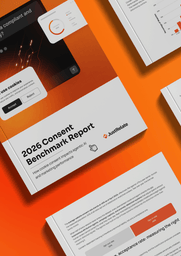
Why the consent gap is a data problem, not just a compliance one
Inside this report, you will discover:
- The 2026 benchmark and the one metric most teams measure wrong — and why the number on your dashboard may describe something other than what your dataset actually contains.
- The banner-design trade-off that raises consent and invalidates it at the same time, plus the four-point standard that separates consent that survives an enforcement review from consent that doesn't.
- Why consent rates track buyer intent rather than data sensitivity — and which traffic sources and industries your measurement quietly undercounts the most.
- How consent-distorted data degrades automated bidding, and why every agentic system trained on the same data inherits the same bias and acts on it.
- The four ways teams respond to the gap, why three of them hit a hard ceiling, and the architecture that closes it structurally rather than chasing it banner by banner.
Incomplete data compounds every quarter
While your dashboards report confident numbers, the systems acting on them — bidding, attribution, autonomous optimization — are tuning to a sample that omits half the room. Each cycle, the model learns a little more from data that was never representative, and the error compounds in a direction the team can't see and can't correct downstream. Optimizing the banner buys a single-digit gain at the margin; it does not close the gap.
If you own the marketing dashboard but not the consent banner, if you've been told the consent rate is a compliance metric and nothing more, or if you can't explain why your highest-intent channels still look like they underperform, this report gives you the framework to see the gap and the architecture to close it.
Six sections of industry benchmarks, segment-level data, and architectural guidance — grounded entirely in etracker's measurement dataset.

Consent rate is the share of all sessions in which statistical or analytical cookies are actually initialized — it describes what your dataset really contains. Acceptance rate is narrower: it counts only sessions where a user interacted with the banner, leaving out returning visitors with stored preferences and immediate bouncers. Both groups are large, so the two metrics can diverge sharply. The report explains why consent rate is the only one that reflects your true data coverage, and how confusing the two produces unreliable benchmarks.
Consent rate is the share of all sessions in which statistical or analytical cookies are actually initialized — it describes what your dataset really contains. Acceptance rate is narrower: it counts only sessions where a user interacted with the banner, leaving out returning visitors with stored preferences and immediate bouncers. Both groups are large, so the two metrics can diverge sharply. The report explains why consent rate is the only one that reflects your true data coverage, and how confusing the two produces unreliable benchmarks.
Not necessarily. A banner that visually privileges "Accept" can lift consent meaningfully — but if that lift comes from nudging rather than a free choice, the consent it collects is legally invalid from the moment of collection, and no later processing step repairs it. The report covers the four-point standard regulators use to judge banner validity and why the downstream cost of a nudged rate tends to exceed its upstream gain.
Not necessarily. A banner that visually privileges "Accept" can lift consent meaningfully — but if that lift comes from nudging rather than a free choice, the consent it collects is legally invalid from the moment of collection, and no later processing step repairs it. The report covers the four-point standard regulators use to judge banner validity and why the downstream cost of a nudged rate tends to exceed its upstream gain.
Because consent tracks transactional intent more than data sensitivity. Visitors who already expect to identify themselves — to buy, book, or log into an account — consent at higher rates than those browsing informational or public-service sites, even when the latter handle more sensitive data. The report breaks down the full industry ranking and what it implies for how you read your own numbers.
Because consent tracks transactional intent more than data sensitivity. Visitors who already expect to identify themselves — to buy, book, or log into an account — consent at higher rates than those browsing informational or public-service sites, even when the latter handle more sensitive data. The report breaks down the full industry ranking and what it implies for how you read your own numbers.
No. This is a common misconception. Where a server-side setup reads device attributes, sets cookies, or sends data to ad networks for user matching, prior consent is still mandatory — and anonymizing data after collection grants no retroactive permission, because personal-data status is fixed at the moment of collection. The report walks through the relevant ECJ ruling and why server-side tracking is not, on its own, a consent solution.
No. This is a common misconception. Where a server-side setup reads device attributes, sets cookies, or sends data to ad networks for user matching, prior consent is still mandatory — and anonymizing data after collection grants no retroactive permission, because personal-data status is fixed at the moment of collection. The report walks through the relevant ECJ ruling and why server-side tracking is not, on its own, a consent solution.
It's an analytics architecture that measures full session-level traffic without storing or accessing data on the user's device in a way that triggers the consent obligation. In practice that means no tracking cookies or fingerprinting, no persistent user IDs, recognition that expires within 24 hours, and IP truncation at the edge before any logging. It can tell you how many sessions arrived from a given channel today and at what conversion rate, with complete coverage — it just can't link a visitor across sessions without consent. The report details all four hard constraints and how the hybrid model layers consented data on top for depth.
It's an analytics architecture that measures full session-level traffic without storing or accessing data on the user's device in a way that triggers the consent obligation. In practice that means no tracking cookies or fingerprinting, no persistent user IDs, recognition that expires within 24 hours, and IP truncation at the edge before any logging. It can tell you how many sessions arrived from a given channel today and at what conversion rate, with complete coverage — it just can't link a visitor across sessions without consent. The report details all four hard constraints and how the hybrid model layers consented data on top for depth.

Which problem can we solve for you?
Every figure in this report describes the industry. The number that matters is yours. etracker, part of the JustRelate Group, runs a 30-day parallel deployment alongside your existing stack to measure the consent gap on your own live site — and shows the absolute size of the dataset your team and your AI systems are already missing.