10 successful Welcome Emails examples: Tips and best practices to inspire your Campaigns
Read ArticleCRM & Marketing Strategy
November 2026
Your next customer is an AI agent. Can it use your website?
Agentic commerce explained: what it is, where it already happens, and what your website needs so AI agents can find, compare and choose you.
Two purchases, one week apart.
On Monday evening, Anna asks the AI assistant on her phone to find running shoes: size 39, under 150 euros, delivered by Friday. She doesn't open a single shop. Ten minutes later she gets three options with prices and delivery dates. She taps one and confirms.
On Thursday morning, Markus, a buyer at a food-processing company, asks his AI assistant to shortlist three valve suppliers with a valid hygiene certificate and delivery within six weeks. He gets a comparison table. One supplier has two empty cells: certificate and delivery time. Both facts are on that supplier's website, one inside a PDF, one in a sentence on a contact page. Markus forwards only the complete rows.
Neither Anna nor Markus visited the websites they bought from or rejected. Their agents did. That is agentic commerce, and it changes who your website has to convince.
What agentic commerce is
Agentic commerce means an AI agent searches, compares and, with permission, buys on behalf of a person or a company. The human sets the goal and the limits. The agent does the legwork: it opens websites, reads product pages, fills in forms and reports back.
The difference to what came before is agency. A search engine lists links. A chatbot answers questions. An agent completes a task.
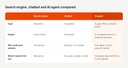
The agents doing this work are consumer apps, browser extensions and enterprise tools: personal assistants like Meta's Muse, browser agents like Claude in Chrome, and procurement agents inside purchasing software.
Where it already happens
In little more than a year, agentic commerce has moved from demos to live products in both consumer and business buying.
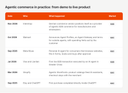
On the buyer side, the shift is already measurable in B2B: according to Deloitte's 2026 B2B commerce research, nearly 40% of US B2B buyers use agentic AI in purchasing, for example to evaluate products, configure orders and benchmark suppliers.
What it changes
When an agent stands between you and your customer, your website is judged on what software can read and use, not on what people see.
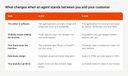
The most dangerous outcome is the quiet one: the agent reaches your site, extracts half the facts and moves on. Nobody tells you that you were in the running.
Reality check: research now, buying later
Autonomous checkout is arriving slower than the headlines suggest, while agent-driven research is already everyday behavior.
- Checkout is still rare. OpenAI discontinued Instant Checkout in March 2026 because adoption stayed low. A Checkout.com report from June 2026 found that 89% of merchants are preparing for agentic commerce, but only 3% have seen actual agent transactions.
- Research is mainstream. In a Deloitte survey of 13,500 European consumers (May 2026), 52% of Germans had already used AI for shopping. Asked what they would hand to an agent, 34% named finding the best price and 27% comparing products, only 8% checkout and payment.
- People keep the final decision. In B2B, Gartner found that 45% of buyers used AI in a recent purchase, mainly to research vendors, and 69% prefer to validate AI results with a sales rep.
For your business this means: the agent may not place the order yet, but it already decides who makes the shortlist. A person can check what a comparison contains. Nobody can see what it left out.
What agents need from your website
In a controlled experiment, a shop rebuilt for agents raised fully completed tasks from 49% to 89%, with the same products, prices and checkout.
Researchers Said Elnaffar and Farzad Rashidi published the study in July 2026. Browser agents based on GPT-4.1, Gemini 2.5 Flash and Grok 4 Fast completed five shopping tasks, 300 runs in total, on two versions of the same prototype shop. On the ordinary version, agents reached the main goal in 78% of runs, but met every requirement in only 49%. The gap was incomplete answers: the right product, with facts missing. The agent-ready version cut those partial runs from 43 to 3. Its changes were plain: product data also published as structured data, explicit labels on controls, product IDs and stock on action buttons, and dated evidence for claims. No agent protocol was involved.
It is one prototype shop, and the authors call it a proof of concept. But the pattern matches what we see on real websites. These are the gaps that cost the most:
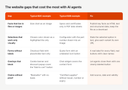
Most of these fixes also help people using screen readers. Agent readiness and accessibility largely overlap.
What to fix first
Start with the data and the forms on your most important pages. Protocols can follow once agents actually ask for them.
- Product and offer data in plain HTML. Prices, variants, availability, specs, certificates, lead times. Add structured data on top.
- Operable forms and flows. Labeled fields, real buttons, overlays that close, no CAPTCHA on the core path, a guest option.
- Claims with evidence. Source, date and validity for certificates, ratings and promises.
- Know your agent traffic. Identify agent visits in analytics, decide which agents you allow, and keep a human confirmation step before anything is ordered or sent.
- Interfaces for agents. APIs or MCP endpoints make sense where customers or tools need direct, programmatic access. Proposed standards like WebMCP are still in testing and worth a pilot, not a rebuild.
Agent readiness builds on the work you may already be doing:

Find out how agents see your website: the JustRelate Agent Readiness Audit
Our Agent Readiness Audit shows whether AI agents can complete your customers' most important tasks on your website, where they fail, and what to fix first.
Many scanners check technical signals. We test what matters: real tasks, run by real agents.
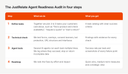
The audit follows the same proven approach as our GEO Audit. GEO shows how AI describes you. Agent readiness shows whether AI can act on your offer. Together they cover both sides of AI-driven buying, for B2C shops and B2B websites alike.
Frequently asked questions
What is agentic commerce?
Agentic commerce is buying and selling in which an AI agent searches, compares and, with the user's permission, purchases on behalf of a person or company. The human sets the goal and limits, the agent carries out the steps.
Is agentic commerce relevant for B2B or only for consumers?
Both. Consumer agents like Meta's Muse handle shopping tasks, while business buyers use agents to research suppliers and compare offers. In B2B, research by agents is already common, while autonomous ordering is still at an early stage.
What is an agent-ready website?
A website whose content, forms and data an AI agent can read, verify and use to complete a task for a person, such as comparing products or requesting a quote.
Do I need an MCP server or llms.txt to be agent-ready?
Not to start. In the Elnaffar and Rashidi experiment, the gains came from clear data, labels and evidence, without any agent protocol. Interfaces like MCP become relevant where customers or tools need direct, programmatic access.
How is agent readiness different from GEO?
GEO makes sure AI answers describe your company correctly. Agent readiness makes sure an agent can complete a task on your website. One gets you mentioned, the other gets you chosen.
Sources
- Elnaffar and Rashidi: Designing Agent-Ready Websites for AI Web Agents (2026)
- Meta: Introducing Muse
- Everything PR: Best agentic commerce cases (Etsy, Shopify, Walmart)
- Forkast: Visa and Lianlian first live B2B agentic transaction
- Inriver: Why B2B agentic commerce can't run on retail protocols
- Intershop Fall 2026 Release
- Deloitte European consumer survey (May 2026)
- Gartner B2B buyer survey (2025)
Our top article
Artificial intelligence and emails: How to speed up the creation and design processes of your campaigns?
Read ArticleTrigger emails strategy: a weapon for engagement and retention
Read Article